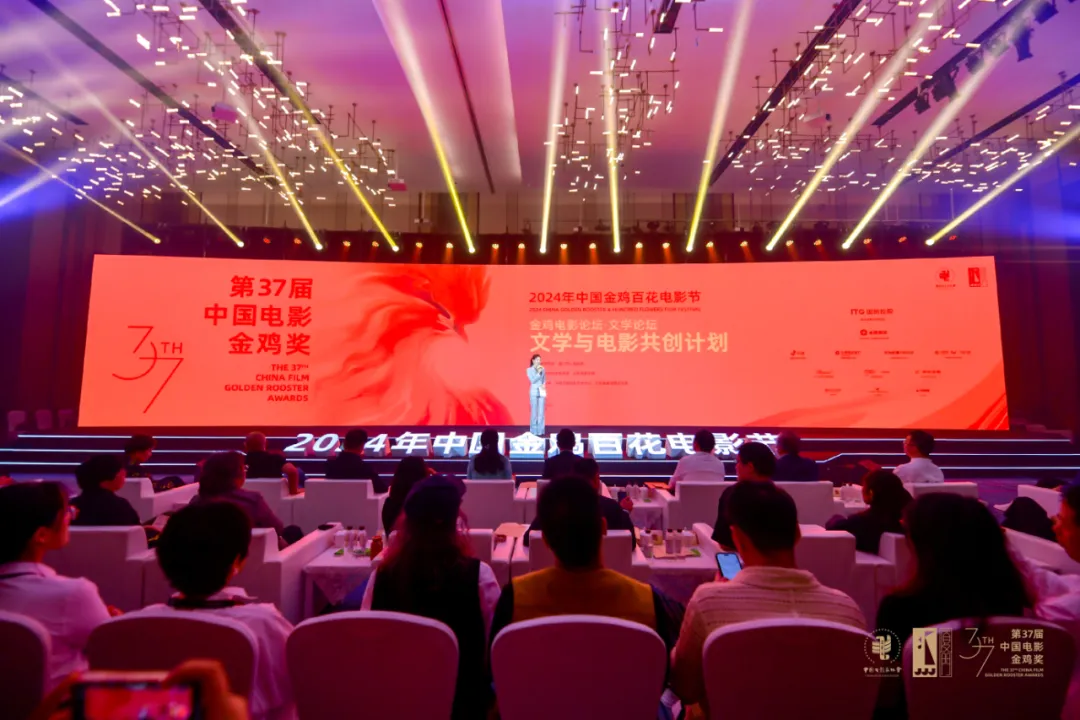
Summit Forum · Academic Summit: “Celebrating the 70th Anniversary of the Founding of the People’s Republic of China”
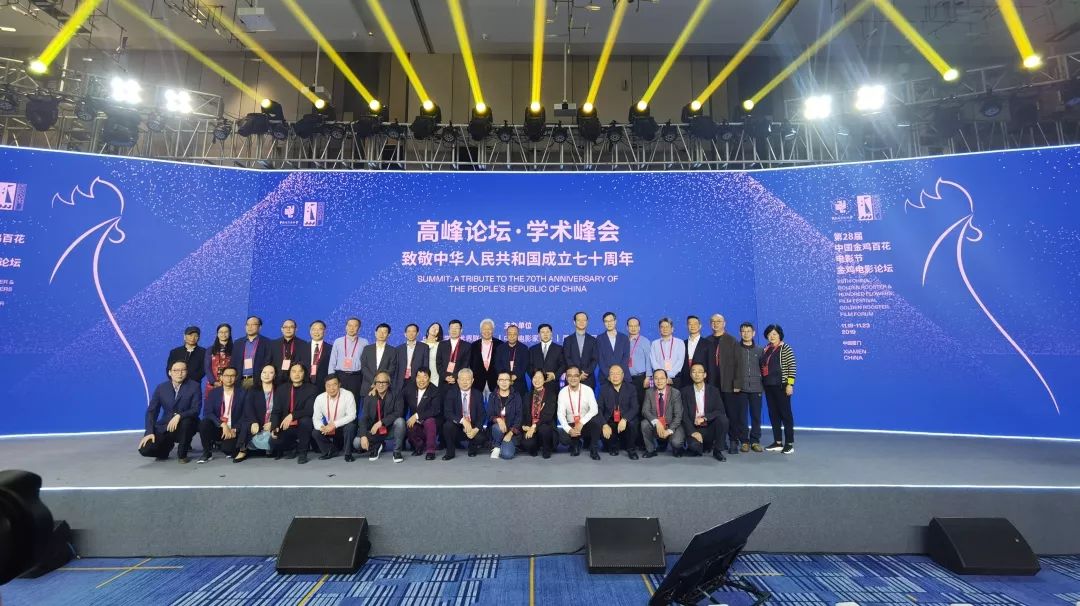
2019–11–22: The “28th China Golden Rooster & Hundred Flowers Film Festival Summit Forum · Academic Summit” was held in Xiamen, Fujian. The forum was jointly hosted by the China Federation of Literary and Art Circles, the China Film Association and the Xiamen Municipal People’s Government. Directors working at the forefront of filmmaking and senior scholars gathered for in-depth discussions on the theme “Celebrating the 70th Anniversary of the Founding of the People’s Republic of China”. The Summit Forum was hosted by Yu Qiao, a presenter with China Media Group, and the academic sessions were moderated by Huangfu Yichuan, researcher at the China Film Art Research Center and editor-in-chief of Contemporary Cinema; Wu Guanping, Executive Dean of the Chinese Film Culture Research Institute at the Beijing Film Academy, professor and editor-in-chief of the Journal of Beijing Film Academy; and Tan Zheng, researcher at the Film Art Center of the China Federation of Literary and Art Circles and executive editor-in-chief of Film Art.
I. Directors’ Memories of China on Screen and Their Creative Experience
Departing from the traditional format of experts holding forth, this year’s Summit Forum had directors share their creative experience and hold dialogues with experts, recreating the lively exchange between theory and practice of the 1980s.
Huang Jianzhong, a representative of the Fourth Generation of directors, recalled his path in filmmaking, in particular making his debut feature Ru Yi, and spoke of how senior filmmakers such as Chen Huangmei, Tian Fang, Xie Jin, Wang Yan and Shui Hua guided his work and influenced him as a person. Fifth Generation director Huang Jianxin, chief producer of My People, My Country, a film made to celebrate National Day, reviewed the film’s development, production and marketing. Huang Jianxin stressed that the film needed to “relate closely to the feelings of ordinary people” and “share the breath and fate of the audience, filming the ways they are moved and how they express true feelings”. On this basis, the film was positioned as “historic moments, collective memory, head-on encounters”, selecting moving moments from seven events in the collective memory of the past 70 years and focusing on “the tenderness and idealism deep in the hearts of the most ordinary people”. Yin Li, Vice Chairman of the China Film Association and director of main-melody films such as The Knot and Zhang Side, looked back on why he started making films and pointed to two encouraging trends: young directors are emerging in large numbers, and filmmaking is returning to the realist tradition.
Director Chen Li brought The Bugle from Gutian, nominated for Best Picture at the Golden Rooster Awards, to the forum and held a brief dialogue with Huangfu Yichuan. Looking back on her directing career from Young Mao Zedong to The Bugle from Gutian, Chen Li said: “Major historical subjects are hard to film. You need to understand the history clearly and also capture the most vivid characters.” To this end, one must “immerse oneself in life”, and stories on major subjects must be told “in a down-to-earth way”. Huangfu Yichuan said Chen Li holds a special place in contemporary Chinese cinema: as a woman director working in both film and television, she has achieved notable success in both, and the most prominent feature of her work is its response to the times and to history.
II. Looking Back on 70 Years of China’s Dream on Screen: A Historical Review and Critical Examination
In line with the forum theme, discussion focused on the historical development of 70 years of film in New China. Over these 70 years, New China’s cinema has gone through major turning points and development together with the country. Experts and scholars therefore largely divide its history into periods according to social and political eras. Their systematic review of its historical evolution and reflections combining history and theory were carried out at different levels and from different angles.
In his address, Rao Shuguang, Director of the Film Art Center of the China Federation of Literary and Art Circles, summarized the aesthetic character and evolution of Chinese cinema in different historical periods as “upholding fundamentals, innovation, adapting to change, and integration”. Films of the “Seventeen Years” raised the banner of heroism and established the cultural gene of “upholding fundamentals” in New China’s cinema. In the new period, the Fourth and Fifth Generation directors made the “spirit of enlightenment” and “artistic innovation” the new dominant aesthetic, bringing about a high point in filmmaking. From the slump of the 1990s to the golden age of “thriving supply and demand” since the start of the 21st century, Chinese cinema opened a new paradigm of “reform and adaptation”. Since entering the new era in 2012, the film paradigm has shifted from high-speed growth to high-quality development aiming at new peaks, forming an aesthetic of “integration”.
Yin Hong, Vice Chairman of the China Film Association and professor at the School of Journalism and Communication, Tsinghua University, gave a historical review and theoretical summary of New China’s mainstream cinema, arguing that mainstream cinema consists of three elements: shared values, the melodrama genre and the mass market. Mainstream cinema has passed through the socialist cinema of New China, the golden age of the new period, and the three-way division among main-melody films, entertainment films and art films at the turn of the century, and has developed into the new mainstream cinema of the new era.
Wang Yichuan, professor at the School of Arts, Peking University, divided the shaping of China’s image in 70 years of film into three stages: first, in the 30 years before reform and opening up, an image paradigm of “standing up” took shape, underpinned by a revolutionary aesthetic; second, since reform and opening up, an image paradigm of “seeking prosperity” has formed, underpinned by a reform aesthetic; third, since the start of the new era, an image paradigm of a China “striving for strength” has formed, in three types: documentary-style, tradition-based and global striving for strength.
Chen Xuguang, professor at the School of Arts, Peking University, explored how concepts of Chinese cinema have changed over 70 years from the perspective of a “big cinema” concept. Over these 70 years, concepts of Chinese cinema have evolved along aesthetic, artistic, cultural and industrial dimensions, influencing the industry’s overall creative thinking, critical perspectives, industrial scope and industrial system. The “Seventeen Years” of New China were the period of “national cinema” theory, which viewed film’s function as propaganda and education, and of red cinema; the early years of reform and opening up saw a return to art and cultural reflection amid the tide of ideological emancipation; the years of transition to a market economy showed the conflict and tension between art and the market; and the new century has seen the rise of industrial, popular-culture and industrialization concepts of film.
Lu Shaoyang, professor at the School of Journalism and Communication, Peking University, studied Chinese cinema from the perspective of the economic system and prices, dividing the 70-year development of Chinese film into two periods: the planned economy stage from 1949 to 1992, when prices barely changed; and the socialist market economy stage from 1993 to the present, when prices change with the market.
Fan Zhizhong, professor at the College of Media and International Culture, Zhejiang University, systematically reviewed and reflected on the evolution of Chinese film theory over a century. He argued that theory liberates the productive forces of film and promotes its prosperity when it enters into dialogue with filmmaking. Faced with a new century, new technologies and new markets, however, film theory has to some extent lost its voice, which has left filmmaking somewhat disoriented.
Departing from the chronological approach of film history, Zhang Ali, professor at the School of Liberal Arts, Northwest University, took 1979, an important historical turning point, and analyzed in detail the film output of a state-owned local studio. In 1979, Xi’an Film Studio set things right after the years of chaos, emphasized reforms in film technology and incentive systems, pursued artistic democracy and valued young talent. It produced films such as Ru Yan Fei and Tremolo of Life, developing characteristics including realist expression, exploration of documentary aesthetics, a commitment to national and local character, and diverse output across art films and commercial films.
Zhao Weifang, researcher at the Film and Television Institute of the Chinese National Academy of Arts, divided the interaction and mutual influence of film in the Chinese mainland, Hong Kong and Taiwan over 70 years into three stages: 1949-1979 was a period of a stable “single whole”; 1980-1999 was a period of differentiated “diversity”; and since 2000 there has been a new pattern of “diversity within unity”. Over 70 years, through integration and interaction, Chinese cinema in the three regions has maintained a unity bound by traditional Chinese culture while displaying the distinctive appeal of diversity.
III. Theoretical Research on Film and History
Building on their review of 70 years of film history, participating experts examined theoretical questions such as the relationship of national historical memory to filmmaking and film acting, and how film expresses history, offering in-depth theoretical reflection for the study of 70 years of Chinese film history.
Film is the electronic monument of our time and plays an important role in reconstructing the historical memory of the nation and the people. On this basis, Jia Leilei, researcher at the Chinese National Academy of Arts, raised the theoretical question of how film should tell history: first, it should uphold a just position in telling history; second, the narrative focus on historical figures should show the strength of character in the course of history rather than repeat their social and historical achievements; third, it should present poetic images amid historical upheaval to evoke lasting reflection on historical justice.
Chen Yang, professor at the School of Liberal Arts, Renmin University of China, pointed out that film shaped by a historical outlook has a poetic quality, and that China’s historical transformations all find clear expression in film. The national memory expressed in New China’s cinema matches the personal memories of most Chinese people, and the masses created an “aesthetics of simplicity”. Since reform and opening up, stories of Chinese people’s growth have become the main narrative of Chinese cinema, resonating strongly with contemporary Chinese audiences. The spirit of self-reliance, self-improvement and self-confidence of the Chinese people has become an internal narrative driving force in contemporary film, forming a new narrative aesthetic.
Li Zhenlin, professor at the School of Film and Television, Shanghai Theatre Academy, discussed the history, significance and system of Chinese film acting from an aesthetic and philosophical standpoint. He argued that film acting is a “relic” of images awaiting “archaeology”; it is the history of the image and spirit of New China, a “national album” of New China presented with deep feeling and in costume.
Zhou Anhua, professor at the Asian Film and Media Research Center, Nanjing University, explained the connection between revolutionary films with heroic narratives and modern expressionism: both are grounded in a philosophy of struggle, emphasize the masses, and transform ideas through a radical attitude.
Cheng Bo, professor at the Shanghai Film Academy, Shanghai University, reviewed a series of films marked by a reflexive and intertextual “meta-cinema” awareness and considered theoretical questions such as the localized development of genres and the diverse expression of art cinema. He advocated building a high-quality, handcrafted Chinese “cultural luxury”, that is, art cinema with a niche and elite awareness.
IV. Genre Construction and Mainstream Expression in Filmmaking
In studying 70 years of Chinese filmmaking, participating scholars focused on genre construction and mainstream expression.
Genre film research has been a focus of academic attention since the start of the new century, and science fiction in particular has drawn attention following the breakthrough of The Wandering Earth. Zhang Wei, Executive Vice President of the China Film Critics Association, traced the development of Chinese science fiction film over 70 years from a historical perspective and offered suggestions for the genre concerning upgraded concepts, state awards, strategic upgrading and public opinion incentives. Zhang Zhihua, professor at the School of Arts and Communication, Beijing Normal University, reviewed the development of biopics over the 70 years of New China and called for addressing problems such as insufficient depth and failure to fully present the inner thoughts and personal charisma of their subjects. Zhao Xiaoshan, professor at the School of Liberal Arts, Lanzhou University, analyzed recent trends and problems in Chinese romance films, proposing that romance films should center on the screenplay and the actors’ performances, emphasize emotional expression, blend genres, and explore and express reality.
Yang Liu, associate professor at the School of Arts and Communication, Beijing Technology and Business University, said that film adaptations of mythological novels need to build national cultural values. First, they should carry forward tradition through critical selection and discernment, integrating fine traditional culture into the contemporary system of mainstream values and using yin-yang thought to build narrative logic and models with Chinese characteristics. Second, they should transform traditional values for modern times, enriching traditional culture with contemporary relevance and broadening psychological identification with traditional culture through shared values, while seeking empathy and resonance with audiences in their expressive strategies.
Yao Rui, associate professor at the School of Journalism and Communication, Guangzhou University, defined “film series” from the perspective of industrial development and systems, describing them as a narrative system for exchange among texts, audiences and the industry, an upgraded iteration of the IP production model, and the 2.0 stage of genre film development.
Mainstream filmmaking is also a current research focus. Film critic Zhou Liming discussed the potential of anthology films through My People, My Country, proposing approaches such as integrating and grafting multi-strand narratives, and assembling anthology films from selected outstanding short films. Liu Fan, associate researcher at the Chinese National Academy of Arts, proposed that against the backdrop of great-power competition, Chinese characters should tell stories on behalf of humanity and explore global and cosmic space, giving mainstream films greater imaginative scope.
V. Analysis of 70 Years of Chinese Film Industry Development
In the new era, the film industry mechanism with Chinese characteristics has become a focus of industry research. Zhi Feina, associate senior editor at the Film and Television Institute of the Chinese National Academy of Arts, discussed the impact of the 2018 transfer of film administration functions on film development: the top-level design of the film management system, which requires keeping to the correct political direction and strengthening value guidance, became a turning point for the development of the film market. Zhi Feina further described the reform and practice of production and distribution mechanisms for film with Chinese characteristics in the new era.
Wang Zhimin, professor at the Beijing Film Academy, discussed how to calculate the values that distinguish a major film country from a leading film power. He said that being a major film country reflects the degree of development of a country’s film market, determined by the world ranking of its annual total box office and the world ranking of its total box office over ten consecutive years. Being a leading film power reflects the share that the combined domestic and overseas box office of a country’s films holds in total worldwide box office. Wang Zhimin proposed a specific indicator for a leading film power: Chinese films accounting for 25% to 35% of global box office revenue.
Liu Jia, an expert in Chinese box office analysis, pointed out that in the twenty years of industrialization, China’s exhibition market has passed three milestones: in 2009, 4,723 screens and box office of 6.2 billion yuan; in 2010, 6,200 screens and box office exceeding 10 billion yuan; and in 2012, 13,000 screens and box office of 17 billion yuan, ranking second among global film markets. The foundation for the growth of the exhibition market was the reform introducing the cinema chain system. In 2017, China’s exhibition capacity ranked first in the world. This matters because it has improved and enriched people’s cultural and entertainment lives and met their cultural needs, and because a solid exhibition network has created a positive feedback loop in the film industry.
Wu Lixiang, founder of Yule Ziben Lun, observed the capitalization of the film industry from 2014 to 2019 from a media perspective. He noted that 2014 was the year capitalization of the film and television industry began; the entry of capital and the financialization of film and television promoted the development of the film industry but also brought risks and bubbles. Since 2015 the industry has become increasingly rational, and the works that have truly succeeded in the market are those that follow market rules and break new ground for the industry.
Liang Junjian, associate professor at the School of Journalism and Communication, Tsinghua University, examined the impact of the internet on Chinese cinema since 2010: first, it has provided film production and distribution with aggregated capital from the market; second, the internet’s user-oriented, market-oriented principles have helped young people who understand users better become a new force in film; third, online and advance ticket sales account for a growing share of opening-day box office, changing distribution methods; fourth, in terms of film culture, it has on one hand promoted the development of other industries and on the other to some extent shaped our forms of discourse and behavior.
VI. Development Strategies and Approaches Toward New Peaks in Film
Chinese cinema is at a critical stage of moving from a plateau to a peak and from a major film country to a leading film power. Participating experts discussed and analyzed the problems and challenges facing film today and offered forward-looking thoughts on its many future possibilities.
Zhi Feina pointed out the challenges and opportunities for the development of a film industry with Chinese characteristics in the new era: first, technological change, as 5G and artificial intelligence bring major transformations to film; second, product change, as film will polarize toward the refined and the socialized; third, channel change, as the desire for private spaces will lead to the demise of pre-modern cinemas; fourth, a change of target, as the object of production, distribution and exhibition shifts from viewers to users, ultimately leading to interactive moving-image expression between people and machines; fifth, philosophical change, as film should be studied within the framework of cognitive science; sixth, management change, requiring top-level design so that film administration and the management system are implemented effectively.
These comprehensive changes will bring transformation and leapfrog development to film, and it can be expected that in the near future Chinese cinema will reach new peaks. Yin Li said: “As I understand it, peaks are classic works that have stood the test of the times and of time.” Peaks cannot emerge without a new generation of film talent. Lu Haibo, professor at the Central Academy of Drama, analyzed the collective rise of the new generation of directors and its significance, pointing out that the transformation of filmmaking concepts and the enrichment of film genres have created a situation in which a hundred flowers bloom and Chinese cinema continues to prosper, and that its momentum is irreversible.
On filmmaking, Yin Hong stressed that new mainstream films should pursue empathy, resonance and sharing, and handle the tensions and relationships between individual and nation, tradition and modernity, and China and the world. Wang Yichuan said that creating China’s image in Chinese cinema requires continued efforts in three areas: diversity, global reach and the pursuit of peak achievement. Fan Zhizhong proposed that Chinese film theory in the internet era must build a theoretical discourse that truly fits the times; only then can it embody the theoretical confidence of Chinese cinema and promote the prosperity of filmmaking. Cheng Bo outlined a path for the development of Chinese cinema: from “I” to “meta”, using “meta” to connect with the “archetypal culture” of its origins and so become a “greater self”, so that niche films become “big cinema” and reach the level of handcrafted works of art, representing, together with other films, the peak of Chinese cinema. Li Xiaohong, professor at the School of Liberal Arts, Xiamen University, proposed strategies for developing Chinese-language cinema in Xiamen based on the city’s characteristics. Huang Haikun, editor-in-chief of Movie View, pointed out that the push into new technologies and the attention to and reflection on reality signal that a new era of film is arriving. As the Hollywood model declines, the Chinese narrative model is bound to rise, and the world’s new film center is very likely to be China.
“Going global” is the necessary path for China to become a leading film power, and co-productions are an important mode and vehicle of production. Shao Qi, associate professor at the School of Media and Communication, Shanghai Jiao Tong University, described the current state of and problems in China-Russia co-productions and proposed solutions: China-Russia co-productions should tell each side’s stories well and integrate them with care; find subjects that interest both Chinese and Russian audiences; and seek a variety of genres, drawing on each side’s strengths. Liu Hanwen, researcher at the Film and Television Institute of the Development Research Center of the National Radio and Television Administration, proposed six strategies for going global: strengthen top-level design and improve the policy system supporting Chinese films going global; strengthen guidance from the concept stage; introduce targeted policies for different countries and regions; cooperate with the Ministry of Foreign Affairs, the Ministry of Education and other relevant ministries; nurture institutions and talent for going global; and strengthen performance evaluation of going-global work, adjusting relevant policies as needed.