Golden Rooster Film Forum · Opera Film Forum: Exploring the Aesthetics of Chinese Opera Films in the New Era

On 2 November, the “Golden Rooster Film Forum · Opera Film Forum”, hosted by the China Film Association and the Xiamen Municipal People’s Government and organised by the Film Art Center of the China Federation of Literary and Art Circles and the Opera Film Committee of the China Film Association, was held in the Zijin Hall of the Tianyuan Hotel in Xiamen. The theme of the forum was “Exploring the Aesthetics of Chinese Opera Films in the New Era”.
Attending the forum were Ren Zhonglun, Vice Chairman of the China Film Association; Lu Haibo, Professor at the Central Academy of Drama; Li Jinlin, Party Secretary, Vice Dean and Professor of the Huace Film Academy of the Communication University of Zhejiang; Teng Junjie, Vice Chairman of the Shanghai Federation of Literary and Art Circles and Chairman of the Shanghai TV Artists Association; Meng Zhonghua, Vice President of the Opera Film Committee of the China Film Association, director and art designer; director Zhu Zhaowei; Peking Opera artist Yu Lan; Mao Shanyu, Shanghai Opera (Huju) artist and inheritor of national intangible cultural heritage; Sun Jinhua, member of the Party Committee, Deputy General Manager and producer of Pearl River Film Group Co., Ltd.; Chen Guofu, Vice President of the Opera Film Committee of the China Film Association; and representatives of the creative teams of opera films from across the country. The forum was moderated by Xiong Yingli, Vice President and Secretary-General of the Opera Film Committee of the China Film Association.
In his address, Ren Zhonglun noted that Chinese cinema has been closely bound to traditional opera since its birth: China’s first film, The Battle of Dingjunshan (1905), China’s first colour film, Remorse at Death (1948), and New China’s first colour film, Liang Shanbo and Zhu Yingtai (1954), were all opera films. The opera film is a genre unique to Chinese cinema, a cultural achievement in which Chinese film and Chinese opera complement and accomplish each other, and a major contribution and valuable asset that Chinese cinema has given to world cinema. In the new era, opera films have gained new vitality, with output growing steadily year by year and a number of fine works produced. This is the result of opera and film practitioners upholding fundamental principles while breaking new ground and striving continuously.
On the new journey, he hoped that opera film practitioners, guided by Xi Jinping Thought on Socialism with Chinese Characteristics for a New Era, would study and implement Xi Jinping Thought on Culture and the guiding principles of the important speech delivered by General Secretary Xi Jinping at the meeting on cultural inheritance and development, put the “Two Integrations” into practice, focus on innovative development, promote the creative transformation and innovative development of Chinese opera films, and help opera, a treasure of traditional Chinese culture, shine anew on the screen in the new era.
The forum was divided into two parts: keynote speeches and a roundtable dialogue.
Keynote Speeches
In the keynote session, experts and scholars including Lu Haibo and Li Jinlin discussed how opera films can achieve sustainable development through inheritance and innovation. Professor Lu Haibo’s speech was titled “Upholding Fundamental Principles and Breaking New Ground to Promote the Sustainable Development of Opera Films”. He stressed that opera film creation should follow the principle of “Peking Opera as the foundation, film as the means”, ensuring that the beauty of the stylised conventions is not distorted in the process of adaptation to film, while using cinematic means and technology to enhance its effect. Professor Li Jinlin’s speech was titled “Inheritance and Innovation in Opera Film Creation”. He pointed out that carrying forward traditional Chinese culture and developing opera films creatively and innovatively is an important task before us. The inheritance and innovation of opera films requires continued effort and exploration in creative concepts, technological change, policy support and market recognition, so as to find a practical and truly convincing cultural force that can bring about the revival of traditional Chinese culture. Director Teng Junjie, Shanghai Opera artist Mao Shanyu and others drew on their own creative practice to discuss how opera films can fuse the ancient and the modern and produce fine works popular with audiences.
Roundtable Dialogue
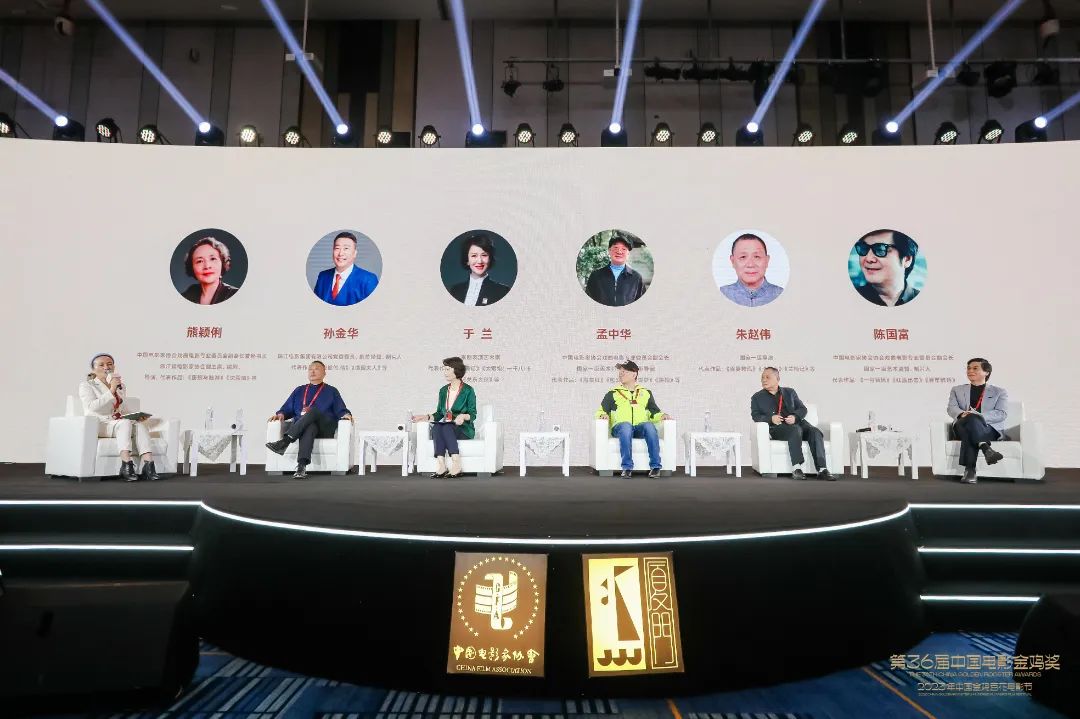
Moderator: Xiong Yingli
Guests from left to right: Sun Jinhua, Yu Lan, Meng Zhonghua, Zhu Zhaowei, Chen Guofu
In the roundtable dialogue, producer Sun Jinhua, director and art designer Meng Zhonghua, director Zhu Zhaowei, Peking Opera artist Yu Lan and Chen Guofu, Vice President of the Opera Film Committee of the China Film Association, discussed the theme “Exploring the Aesthetics of Chinese Opera Films in the New Era”.
Producer Sun Jinhua suggested that opera films should be shot more according to the logic of film, seeking to present the beauty of opera through the beauty of the camera, appropriately improving techniques of expression and making use of film’s advantages in expression and dissemination, while taking care not to sacrifice the distinctive features of opera as an art. Opera films should be made not only for opera fans but also for a wide young audience; only by reaching more viewers can audiences come to know and love opera films.
Yu Lan said that an opera film is not simply a combination of the artistic work of two groups of people, opera practitioners and filmmakers. It is both a composite and a relatively independent art form. It requires dedicated, skilled creative teams and specialists with breadth of vision who do not seek quick results, using multimedia and all-round camera language, including artificial intelligence, to bring out the charm of opera as an art, show the particular character of the opera film, and seamlessly join the singing, recitation, acting and combat skills and the hand, eye, body and footwork of opera performers with stage design, costumes, sound and image that combine the real and the suggested.
Through his practice, Meng Zhonghua has come to see that opera and film have different aesthetic characteristics: opera centres on the actors’ stylised performance and emphasises “freehand performance”, while film aims at a realistic depiction of nature and human society and emphasises “realism”. How to bring the two together, neither confined to the stage nor departing from the characteristics of opera performance, is something every opera film director must consider fully and put into practice.
Zhu Zhaowei noted that today’s opera film practitioners have met a good era. The “Two Integrations” in Xi Jinping Thought on Culture have raised fine traditional Chinese culture to a new height.We should make high-quality opera films in line with the guiding principle of “upholding fundamental principles and breaking new ground”; this is the mission the times have given opera film practitioners to spread fine traditional Chinese culture.
Chen Guofu said that the opera film, as a distinctive art form, has played an important and positive role in popularising, promoting and spreading Chinese opera, has greatly expanded the visual and aesthetic space of opera’s artistic expression, and has given audiences a different artistic experience. How to make good use of modern digital technology to tell compelling stories and how to spread opera more widely remain long-term tasks for opera film practitioners.